
 +86-151 6876 5707

Continuous, bullion, jewelry and centrifugal casting compared
Choose the precious metal casting machine from the finished product
Precious-metal casting is not one process. Downward continuous casting makes long semi-finished profiles; vacuum bullion casting produces dense bars; vacuum-pressure casting fills investment flasks; and centrifugal vacuum casting supports detailed or high-temperature work. This guide keeps the correct models, parameters, images and videos while separating related granulation and burnout equipment from the casting-machine list.

SELECTION LOGIC
Four casting-machine families—not one generic model
The output geometry and mold route determine the machine. Capacity is then confirmed for the actual alloy.
Downward continuous casting
For precious-metal and compatible non-ferrous rod, tube, strip, bar and plate made through a water-cooled graphite die.
- Send the section drawing
- Confirm die and withdrawal direction
- Match caster output to downstream rolling or drawing
Vacuum bullion casting
For gold and silver bars requiring controlled mold filling, reduced gas entrapment and repeatable cavities.
- State bar weight and cavity count
- Confirm mold material and cooling
- Separate melt capacity from finished-bar output
Vacuum-pressure jewelry casting
For investment flasks where vacuum evacuation and controlled pressure assist detailed filling.
- Send flask diameter and height
- Confirm gold / silver alloy and batch
- Define protective gas and casting cycle
Centrifugal vacuum casting
For small detailed castings and selected platinum, palladium, stainless or compatible high-temperature applications.
- Confirm maximum temperature
- State crucible and mold route
- Approve centrifugal tooling and safety enclosure


EQUIPMENT COMPARISON
Precious metal casting process comparison
Use this comparison to select the process family first. Exact models, capacity and tooling are confirmed from the metal and output drawing.
| Casting process | Typical output | Reference models | Key selection data | Not the same as |
|---|---|---|---|---|
| Downward continuous casting | Rod, tube, strip, bar, plate | CDO-JC family | Section, strands, withdrawal and cooling | Upward OFC copper-rod line |
| Vacuum bullion casting | Gold and silver bars | CDO-F series by project | Bar weight, cavities, mold and surface target | Open hand pouring |
| Vacuum-pressure jewelry casting | Investment-cast jewelry | CDO-JP2 / JP4 / JP6 | Flask, alloy, batch, vacuum and pressure | Bullion bar casting |
| Centrifugal vacuum casting | Detailed small high-temperature parts | CDO-CE18 direction | Alloy, crucible, mold and centrifugal cycle | Continuous casting |
Specification note: Published values are selection references. Final usable capacity, cycle time, utilities and configuration are confirmed against the actual metal, charge, process and destination standard.
WORKFLOW
From product drawing to validated casting cycle
- 01
Define the finished output
Send the product drawing, weight, dimensions, tolerance, surface and downstream process.
- 02
Match metal and tooling
Confirm alloy, crucible, graphite die, bar mold or flask dimensions and contamination limits.
- 03
Configure atmosphere and cooling
Select vacuum, inert gas, pressure, temperature measurement and cooling for the chosen casting route.
- 04
Approve the acceptance sample
Agree trial material, production cycle and measurable criteria before tooling and machine acceptance.
ENGINEERING NOTES
Engineering details that change the final machine configuration
Choose the casting process from the required product
Downward continuous casting produces long semi-finished rod, tube, strip, bar or plate through a water-cooled graphite die. Vacuum bullion casting is designed for dense gold or silver bars in prepared molds. Vacuum-pressure jewelry casting fills an investment flask, while centrifugal vacuum casting uses rotational force for small detailed or high-temperature castings.
These processes cannot be represented by one capacity figure. The buyer must state the metal, maximum melt, finished geometry, mold or flask size, surface requirement and production cycle. COOLDO can then match the appropriate melting, atmosphere, vacuum, pressure, die and cooling arrangement.
- Continuous caster: send section drawings and withdrawal direction.
- Bullion caster: send bar weight, cavities and mold material.
- Jewelry caster: send flask dimensions, alloy and casting frequency.
Model selection, tooling and repeatability
Casting-machine performance depends on tooling as much as the main cabinet. Graphite die geometry, mold preheating, flask preparation, vacuum integrity, protective gas, cooling flow and temperature control determine whether the machine can reproduce the intended part or semi-finished section.
Published models remain useful for narrowing power and capacity, but final tooling is confirmed from the actual output. A long strip, hollow tube, one-kilogram bullion bar and detailed platinum casting require different molds and process windows. The quotation should identify included molds, spares, consumables and trial material.
- Approve drawings before mold manufacture.
- Confirm the metal-specific capacity and maximum temperature.
- Define the acceptance sample and measurable quality criteria.
Related equipment belongs in the process—not in the casting model list
A precious-metal granulator prepares uniform grain for alloying, refining or controlled remelting; it is not a continuous casting model. A wax burnout oven removes patterns and conditions investment flasks before jewelry casting; it is also not a casting machine. Both can appear as related process equipment without being presented as variants of the main casting machine.
For a complete workshop, melting, casting, granulation, burnout, rolling, drawing, XRF testing and refining can be arranged as one coordinated process flow. Each machine should be specified for its own operation, capacity, material and quality target.
- Keep granulators and burnout ovens as related equipment.
- Use dedicated pages for refining, forming and testing systems.
- Build the quotation around the full workflow without mixing model families.
TECHNICAL PARAMETERS
Model and operating parameter references
Use these model tables for initial comparison. Final usable capacity, power, cycle time, utilities and configuration are confirmed for the actual metal and production duty.
Technical parameter table 01
| Casting process | Typical output | Reference models | Key selection data | Not the same as |
|---|---|---|---|---|
| Downward continuous casting | Rod, tube, strip, bar, plate | CDO-JC family | Section, strands, withdrawal and cooling | Upward OFC copper-rod line |
| Vacuum bullion casting | Gold and silver bars | CDO-F series by project | Bar weight, cavities, mold and surface target | Open hand pouring |
| Vacuum-pressure jewelry casting | Investment-cast jewelry | CDO-JP2 / JP4 / JP6 | Flask, alloy, batch, vacuum and pressure | Bullion bar casting |
| Centrifugal vacuum casting | Detailed small high-temperature parts | CDO-CE18 direction | Alloy, crucible, mold and centrifugal cycle | Continuous casting |
Technical parameter table 02
| Model | CDO-JC15 | CDO-JC25 | CDO-JC30 | CDO-JC35 |
| Power | 15kw | 25kw | 30kw | 35kw |
| Voltage | Three phase 380V, 50/60Hz | Three phase 380V, 50/60Hz | Three phase 380V, 50/60Hz | Three phase 380V, 50/60Hz |
| Suitable Metal | Gold, Silver, Copper, Brass, Bronze, and their alloys | Gold, Silver, Copper, Brass, Bronze, and their alloys | Gold, Silver, Copper, Brass, Bronze, and their alloys | Gold, Silver, Copper, Brass, Bronze, and their alloys |
| Melting Time | 10min | 10-12min | 10-15min | 12-16min |
| Casting speed | 10-20cm/m | 10-20cm/m | 10-20cm/m | 10-20cm/m |
| Capacity | Gold:3.0 kg Silver: 2.0kg Copper:1.5kg |
Gold:6.0 kg Silver: 4.0kg Copper:3.0kg |
Gold:10.0 kg Silver: 6.0kg Copper:5.0kg |
Gold:20.0 kg Silver:16.0kg Copper:10.0kg |
| Gas | Argon Gas or Nitrogen | Argon Gas or Nitrogen | Argon Gas or Nitrogen | Argon Gas or Nitrogen |
| Temperature | 1500℃ | 1500℃ | 1500℃ | 1500℃ |
| Overall Size | 800*600*1650mm | 900*700*1750mm | 1000*800*1850mm | 1000*800*1850mm |
| Machine Weight | 200kg | 220kg | 240kg | 250kg |
Technical parameter table 03
| Model number | CDO-F1 | CDO-F2 | CDO-F4 |
| Power source | Three phase 380V±10%, 50/60Hz | Three phase 380V±10%, 50/60Hz | Three phase 380V±10%,50/60Hz |
| Power | 25 kw | 35 kw | 75kw |
| Control system | PLC/Manual | PLC/Manual | PLC/Manual |
| Applicable metal | Gold and silver | Gold and silver | Gold and silver |
| Casting time | About 6 min | About 7 min | About 8 min |
| Cooling time | About 7 min | About 7min | About 8 min |
| The Max capacity | 1 pcs of 1kg bar or customized | 2 pcs of 1kg bar or customized | 4 pcs of 1kg bar or 15kg bar |
| Dimension | 1400*700*1200 mm | 1400*700*1200 mm | 1600*700*1200 mm |
| Weight | 150 kg | 210 kg | 230 kg |
| Protective gas | Nitrogen or argon | Nitrogen or argon | Nitrogen or argon |
| Vacuum pump | 63 m³/hour | 63 m³/hour | 63 m³/hour |
| Heating technology | Induction heating | Induction heating | Induction heating |
| Casting mode | Auto and manual mode switch | Auto and manual mode switch | Auto and manual mode switch |
Technical parameter table 04
| Model number | CDO-JP2 | CDO-JP4 | CDO-JP6 |
| Power | 8.5kw | 15kw | 25kw |
| Voltage | 380V, 3 phase, 50/60Hz | 380V, 3 phase, 50/60Hz | 380V, 3 phase, 50/60Hz |
| Casting system | Vacuum pressure casting system | Vacuum pressure casting system | Vacuum pressure casting system |
| Applicable metal | Gold, K-Gold, Silver, Copper, Brass, Bronze, and their alloys | Gold, K-Gold, Silver, Copper, Brass, Bronze, and their alloys | Gold, K-Gold, Silver, Copper, Brass, Bronze, and their alloys |
| Melting time | 3-5min | 3-5min | 3-5min |
| Max capacity | 24K Gold: 2.0 kg 18K Gold: 1.5 kg 925 Silver: 1.0 kg |
24K Gold: 4.0 kg 18K Gold: 3.0 kg 925 Silver: 2.0 kg |
24K Gold: 6.0 kg 18K Gold: 4.0 kg 925 Silver: 3.0 kg |
| Max temperature | 1600℃ | 1600℃ | 1600℃ |
| Protective gas | Nitrogen or Argon | Nitrogen or Argon | Nitrogen or Argon |
| Control of temperature | PID | PID | PID |
| Oscillation | Induction heating | Induction heating | Induction heating |
| Overall size | 720×700×1150 mm | 720×700×1150 mm | 720×800×1150 mm |
| Weight | 210 kg | 215 kg | 250 kg |
Technical parameter table 05
| Model | CDO-CE18 |
| Power | 18kw |
| Voltage | 3P, 380V, 50/60Hz |
| Applicable metal | Platinum / Palladium / Stainless steel |
| Melting time | 2min |
| Max capacity | 300g (platinum) |
| Max temperature | 2000℃ |
| Overall Size | 800*600*1200mm |
| Weight | 230kg |
Technical parameter table 06
| Model | CDO-MG15 | CDO-MG25 | CDO-MG35 | CDO-MG45 |
| Power | 15kw | 25kw | 35kw | 45kw |
| Voltage | 380V, 3 phase, 50/60Hz | |||
| Applicable metal | Gold, K-Gold, Silver, Copper, Brass, Bronze | |||
| Max temperature | 1600℃ | 1600℃ | 1600℃ | 1600℃ |
| Melting time | 8-10min | 10-12min | 10-15min | 20-25min |
| Casting method | Gravity granulation | Gravity granulation | Gravity granulation | Gravity granulation |
| Max capacity | Gold: 10 kg | Gold: 20 kg | Gold: 30 kg | Gold: 50 kg |
| Silver: 5 kg | Silver: 10 kg | Silver: 20 kg | Silver: 35 kg | |
| Overall size | 1100*500*1100mm | 1200*600*1200mm | 1300*700*1300mm | 1400*800*1400mm |
| Weight | 150kg | 180kg | 220kg | 270kg |
Technical parameter table 07
| Model | CDO-RB15 |
| Voltage | 3-phase 380V, 50/60 Hz |
| Power | 15KVA (380V) (including secondary burner) |
| Weight | About 600 kg |
| Dimensions | 1020 *1020*2130mm (including secondary burner) |
| Max temperature | 850 °C |
| Furnace plate | Φ520mmx 2 furnace plates |
| Flask quantity | 37 (φ100mm) 45 (φ89mm) |
| Max height of the flask | 230 (height) mm |
WORKING VIDEOS
See the relevant equipment and process in operation
Review equipment handling, pouring, mold movement and casting behavior before the final process and layout are approved.

Downward continuous casting machine
Production reference for precious-metal rod, tube, strip, bar or plate.
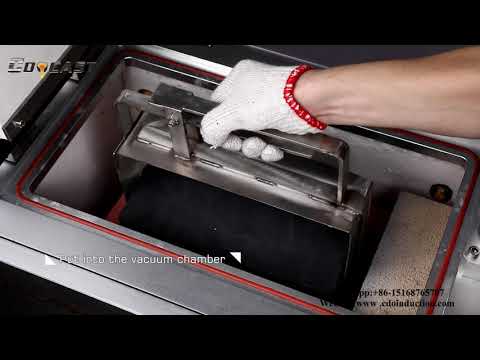
Vacuum bullion casting machine
Working reference for dense gold and silver bar casting.

Vacuum-pressure jewelry casting machine
Investment casting process reference for jewelry flasks.

Centrifugal vacuum casting machine
Centrifugal casting reference for detailed and high-temperature applications.
PROJECT DATA
Information required for a useful casting-machine quotation
A request for 'gold casting machine price' is incomplete without the finished product, metal, tooling and production target.
Product and tooling
- Bar, flask, tree or profile drawing
- Dimensions and tolerances
- Mold, die or flask material
- Surface and density acceptance
- Initial tooling quantity
Metal and production
- Full alloy composition
- Normal and maximum batch
- Cycles or kilograms per shift
- Casting temperature
- Oxidation and contamination limit
Utilities and line scope
- Voltage, phase and frequency
- Cooling-water specification
- Vacuum pump and inert gas
- Compressed air and extraction
- Installation, training and spares
PRICE, DELIVERY AND OWNERSHIP
What determines precious metal casting machine price?
Price changes with casting route, usable metal capacity, furnace power, vacuum and pressure system, automation, mold or die quantity, cooling, protective gas, cutting or collection equipment, pumps, controls, packing and service scope. Compare complete working systems—not only the main cabinet.
Casting route and controls
Bullion, jewelry, continuous and centrifugal casting require different chamber, force, control and safety systems.
Tooling and product range
Each bar size, flask, profile or specialist casting needs approved tooling and may require a separate changeover procedure.
Complete delivered scope
Pumps, chillers, gas controls, compressors, cutters, take-up, spares, packing, commissioning and training affect the real project cost.
FREQUENTLY ASKED QUESTIONS
Precious Metal Casting Machine Buyer Guide FAQ
Which machine is used to make gold or silver bars?
Use a vacuum bullion casting machine with a graphite mold matched to the required bar weight, cavity quantity and cooling cycle.
Which machine is used for lost-wax jewelry casting?
Use a vacuum-pressure jewelry casting machine selected from the alloy, tree weight, flask diameter and height, casting frequency and required automation.
Which machine makes wire, rod, tube or plate?
Use a continuous casting machine with a graphite die and crystallizer engineered from a dimensioned profile drawing and the downstream rolling or drawing process.
When is a centrifugal vacuum casting machine appropriate?
It is used for small detailed castings and approved high-temperature metals such as platinum or palladium where centrifugal filling is part of the validated process.
Can one casting machine perform all four processes?
No. The mold, atmosphere, filling force, cooling and material handling are fundamentally different. Select the process from the finished product.
Can the same stated capacity be used for gold and silver?
No automatic conversion should be made. Density, crucible or mold volume and process limits produce different metal-specific usable capacities.
Why are mold and die drawings required?
Tooling controls dimensions, filling, solidification and surface quality. The drawing must be approved before manufacturing and machine acceptance.
What utilities are normally required?
Requirements may include three-phase power, closed-loop cooling, vacuum, argon or nitrogen, compressed air, extraction and safe hot-metal handling. The final list depends on the selected casting route.
CONFIGURE THE REAL PROJECT
Send the material, capacity and finished-product requirement
COOLDO will confirm the main machine, power, cooling, atmosphere, tooling, auxiliaries and delivery scope against the actual application before quotation.