
 +86-151 6876 5707

Small Hydraulic Tilting Metal Melting Furnace

INDUSTRIAL FERROUS AND NON-FERROUS METAL MELTING
Small Hydraulic Tilting Induction Melting Furnace
The COOLDO hydraulic tilting metal melting furnace combines medium-frequency IGBT heating with remote hydraulic pouring for small and medium industrial batches. Published CDO-HT models are configured around ferrous metals such as steel and stainless steel, or non-ferrous metals such as copper, brass, bronze, aluminum and their compatible alloys.
- 45-160 kW
- Published IGBT power range
- 18-250 kg
- Metal-specific reference capacity
- Up to 95°
- Hydraulic tilting reference
- 1-20 kHz
- Published oscillation frequency
What Is a Hydraulic Tilting Metal Melting Furnace?
A hydraulic tilting metal melting furnace is a crucible induction furnace whose furnace body is rotated by a hydraulic cylinder for controlled pouring. The induction coil transfers electromagnetic energy into the metal charge, while the hydraulic system allows the operator to pour from a safer working position using remote controls.
This COOLDO configuration is intended for industrial foundries, alloy producers, metal-recycling workshops, component manufacturers and pilot plants handling ferrous and non-ferrous metals. It supports faster batch changes than a large refractory-lined furnace when the correct crucible, lining, power level and operating procedure are selected for the metal.
- Ferrous metals
- Steel, stainless steel and compatible iron-based alloys.
- Non-ferrous metals
- Copper, brass, bronze, aluminum and compatible alloys.
- Pouring
- Hydraulic tilting with remote control.
- Production style
- Small and medium industrial batch melting.
Hydraulic Tilting Furnace Design and Safety Features
The furnace must be selected as a complete system: furnace body, induction power, hydraulics, crucible, cooling water and controls.
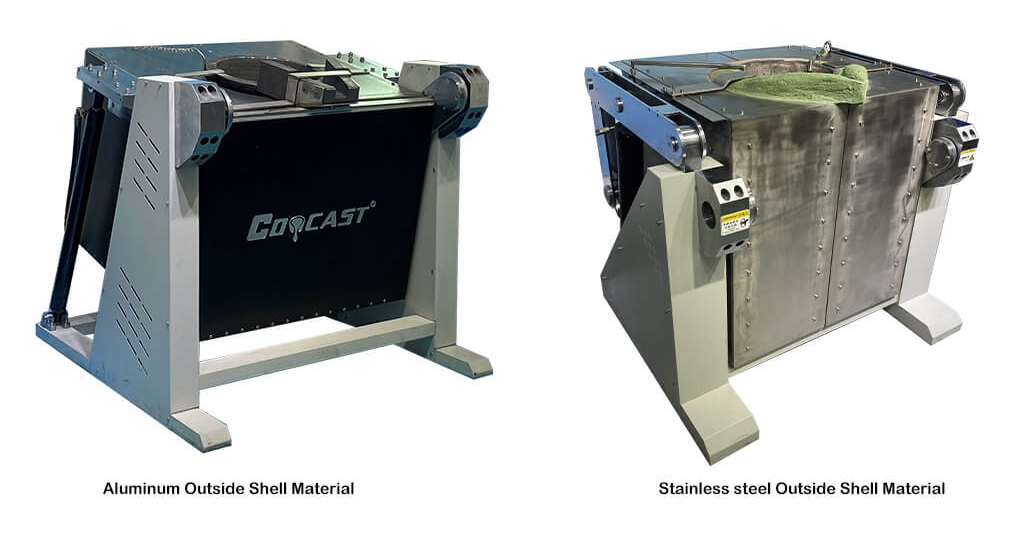
Controlled Hydraulic Pouring
The original product specification states a tilting angle of up to 95 degrees. This helps empty the crucible and supports spot pouring into an ingot mold or casting mold. The remote control lets the operator start, stop and adjust tilting away from the immediate pouring point.
- Hydraulic cylinder provides smooth, controllable rotation
- Remote operation reduces direct exposure at the pouring point
- Pouring speed should match mold size and metal fluidity
- Emergency stop, hose protection and mechanical inspection remain essential
Coil, Frame and Process Monitoring
The induction coil uses high-conductivity thick-wall copper tubing and requires stable cooling-water flow. The original page specifies a durable compact frame, touch-screen monitoring, temperature measurement and optional argon protection for oxidation-sensitive metals.
Crucible material and thermocouple type cannot be universal for every metal. They must be verified against the alloy, operating temperature, atmosphere, batch cycle and contamination limit.

IGBT Power Supply
Provides adjustable medium-frequency induction power for fast heat-up and responsive batch control.
Induction Coil
Water-cooled copper tubing must maintain the specified flow, pressure and inlet-water temperature.
Hydraulic System
Cylinder, pump, hoses and controls rotate the furnace body for smooth and repeatable pouring.
Crucible and Lining
Graphite, silicon-carbide graphite or refractory options are selected for metal compatibility and service temperature.
Temperature Control
Measurement method, sensor and immersion practice are selected for the alloy and required pouring accuracy.
Optional Gas Protection
Argon cover can reduce oxidation for compatible metals but does not replace correct fluxing, cleaning or ventilation.
Hydraulic Tilting Induction Furnace Technical Specifications
Power-supply data and melting capacities from the original product page are combined below. Capacity is metal-specific because density, crucible volume and safe filling level differ.
| Parameter | CDO-HT45 | CDO-HT70 | CDO-HT90 | CDO-HT110 | CDO-HT160 |
|---|---|---|---|---|---|
| Maximum input power | 45 kW | 70 kW | 90 kW | 110 kW | 160 kW |
| Maximum input current | 68 A | 105 A | 135 A | 168 A | 240 A |
| Steel / stainless steel capacity | 18 kg | 25 kg | 40 kg | 50 kg | 100 kg |
| Copper / high-density non-ferrous reference | 50 kg | 80 kg | 120 kg | 150 kg | 250 kg |
| Aluminum / aluminum-alloy capacity | 18 kg | 25 kg | 40 kg | 50 kg | 100 kg |
| Input voltage | Three-phase 340-420 V, 50/60 Hz | ||||
| Oscillation frequency | 1-20 kHz | ||||
Published Cooling-Water Requirements
| Item | Reference requirement | Engineering note |
|---|---|---|
| Water pressure | ≥0.3 MPa | Available pressure must be verified at the machine inlet under operating flow. |
| Flow rate | ≥20 L/min | Final required flow may change with power and cooling-system design. |
| Inlet-water temperature | ≤45°C | Closed-loop industrial water cooling is recommended for stable operation. |
Reference melting time: approximately 20-30 minutes per heat with a hot crucible and 40-50 minutes for the first heat from cold. This is not a universal guarantee; actual cycle time depends on alloy, charge size and form, starting temperature, target superheat, crucible condition, voltage, cooling and operating practice.
Typical Induction Melting and Hydraulic Pouring Process
A written operating procedure must be qualified for the exact metal, crucible and casting method.
Inspect
Check crucible, coil, hoses, hydraulics, grounding, water and interlocks.
Prepare Charge
Sort clean, dry metal and remove sealed, wet or contaminated pieces.
Charge Safely
Load without damaging the crucible and keep charge below the safe fill level.
Melt and Monitor
Apply power progressively; monitor temperature, bath condition and cooling water.
Refine as Required
Skim, flux, deoxidize or protect the melt according to the qualified alloy process.
Tilt and Pour
Use remote hydraulic control to fill the prepared mold smoothly and completely.
Ferrous Metal Melting
- Carbon Steel
- Alloy Steel
- Stainless Steel
- Compatible Iron-Based Alloys
- Small steel casting batches
- Stainless-steel component casting
- Alloy development and pilot production
- Clean ferrous return remelting
- Tool, spare-part and engineering casting
Ferrous-metal operation requires a crucible or lining, temperature-measurement method and power level suitable for the higher melting and pouring temperature.
Non-Ferrous Metal Melting
- Copper
- Brass
- Bronze
- Aluminum
- Aluminum Alloys
- Qualified Non-Ferrous Alloys
- Copper-alloy ingot and billet pouring
- Brass and bronze foundry production
- Aluminum component casting
- Alloy preparation and composition adjustment
- Clean industrial metal return remelting
For copper capacity, alloy and casting-line considerations, see the COOLDO copper melting furnace guide.
How to Select the Correct Hydraulic Tilting Furnace
Metal and Alloy
Provide the exact grade, melting point, pouring temperature and contamination restrictions.
Real Batch Weight
Specify kilograms per heat by metal. The same crucible cannot hold equal weights of steel, copper and aluminum.
Required Output
State heats per shift, tons per day, working hours and required hot-metal availability.
Charge Condition
Describe ingot, granule, return, scrap size, cleanliness, density and starting temperature.
Casting Method
Provide mold size, pouring height, transfer distance and required pouring-rate control.
Plant Utilities
Confirm voltage, transformer capacity, cooling water, floor space, extraction and local standards.
Hydraulic Tilting Induction Melting Furnace FAQs
Clear answers for model selection, metal capacity, melting time, pouring and plant preparation.
What is a hydraulic tilting induction melting furnace?
It is a crucible induction furnace mounted on a tilting frame. A hydraulic cylinder rotates the furnace body so molten metal can be poured into a mold using controlled remote operation.
What ferrous and non-ferrous metals can the furnace melt?
The industrial range is configured for ferrous metals such as steel and stainless steel, or non-ferrous metals such as copper, brass, bronze, aluminum and compatible alloys. Each metal requires the correct crucible or lining, temperature practice and safety procedure.
What is the available melting capacity?
The published model table covers 18-100 kg for steel, stainless steel and aluminum and 50-250 kg for the copper capacity reference. Capacity must always be quoted together with the metal because density and usable crucible volume differ.
Why is copper capacity higher than aluminum capacity in the same model?
The table reports weight, not equal metal volume. Copper has much higher density than aluminum, so a similar usable crucible volume can contain more kilograms of copper.
How long does one melting cycle take?
The original page gives about 20-30 minutes with a hot crucible and 40-50 minutes for the first cold heat. Actual time varies with metal, charge form, batch weight, target temperature, power, crucible and plant voltage.
What is the hydraulic tilting angle?
The original product description states up to 95 degrees. The final usable pouring range and pouring geometry must be confirmed for the selected furnace, crucible and mold arrangement.
Is hydraulic tilting safer than manual pouring?
It reduces manual lifting and lets the operator control pouring from a distance, but it does not remove molten-metal hazards. PPE, dry charge, guarded hydraulics, cooling-water interlocks, emergency procedures and trained operators are still required.
Can the furnace melt steel and aluminum using the same crucible?
Normally no. Crucible chemistry, operating temperature and contamination requirements differ. Use the crucible or lining specified for the metal and review any planned alloy change with the supplier.
Does the furnace include argon protection?
Argon protection is available as a configuration for oxidation-sensitive melting. Required gas purity, cover design, flow and process benefit must be confirmed for the exact alloy.
What cooling water does the induction furnace require?
The published reference is at least 0.3 MPa pressure, at least 20 L/min flow and inlet water no warmer than 45 degrees C. Final water demand must be confirmed for the selected power and cooling package.
Can the furnace work continuously?
The original page describes 24-hour working capability. In practice, the production schedule must include crucible inspection, cooling-system checks, hydraulic maintenance and planned shutdowns according to the approved operating and maintenance instructions.
Does IGBT induction heating save 20 percent energy?
The former product page makes this comparison with KGPS technology, but actual energy use depends on model, load factor, metal, charge condition, insulation, cycle and electrical system. Project energy consumption should be treated as an engineering estimate unless contractually tested.
What is needed to install a hydraulic tilting melting furnace?
Typical requirements include suitable three-phase power, transformer capacity, closed-loop cooling water, grounding, floor loading, fume extraction, dry charging area, safe pouring zone and compliance with local electrical and machinery rules.
What information is needed for a quotation?
Send the metal grade, kilograms per heat, heats per day, charge form, target melting and pouring temperature, mold arrangement, available voltage, transformer capacity, cooling-water conditions and installation country.
Need a Hydraulic Tilting Furnace for Your Metal and Batch Size?
Send the alloy, batch weight, daily output, voltage and casting method for a matched furnace and power-supply proposal.